

Listening isn't reading - it's prestige laundering
How the book/audiobook debate obscures legitimate hierarchies of effort

What’s up, friends? I’m back, and I missed you. My break was fruitful, filled with reading and thinking without the pressure of a publishing cadence. I realized all my work on gender reflects a larger problem of which gendered phenomena are a microcosm - the decline of deep thought and the attendant erosion of judgment. You’re going to read about Neil Postman a lot in the coming weeks.
Edit: here is part 2, addressing many critiques of part 1 and of this note.

Today, I want to demolish the socially convenient lie that hearing a book is equivalent to reading it. This builds toward a larger argument I’ll unfold this month, which the audio/reading debate is a microcosm of.
This isn’t about the medium. When people argue about this, they’re usually saying something like, “I retain the facts just fine,” and some studies show that narrative retention is the same. But that is beside the point. The retention of facts doesn’t shape the mind, but rather the application of ideas does. My contention is about the absorption of ideas. We are a society uniquely founded on the power of Enlightenment principles, the foremost of which is that man can self-govern through his individual reasoning. We rebelled against authoritarianism because print culture enabled long-form political reasoning.
Alexander Hamilton, whose biography I’ve been rereading, is a shining example of what Neil Postman called the typographic mind. America was founded on this type of mind. Our founding documents took on a sacred character because we were committed to procedural liberalism and eliminating the threat of government coercion through reasoned judgment. These ideas spread through print and could not have any other way because they required a citizenry capable of following a long and complex chain of argumentation and holding contradictions without resolution.
Hamilton is the chief architect of the U.S. government, and his rise would be improbable today. He came from the Caribbean and rose meritoriously because he read voraciously and wrote constantly — he did, in fact, as the musical said, write basically every second he was alive. This brilliant mind, shaped by wide reading and writing, could not have architected the government without sustained intellectual activity. All the Founding Fathers wrote, but Hamilton wrote himself into history and wrote the government into existence by sheer force of will. His writing is representative of his high level of agency, because writing is itself an expression of will. You are asserting your ideas with confidence. My confident tone is precisely what agitates some. Agency and judgment stem from effortful engagement with ideas and deciding what to keep and discard.
The act of reading forces you into a dialectic with the author’s mind. You are engaging, stopping, rereading, thinking about the claims, and connecting the ideas to other ones you’ve read. My mind would be hollow without all of the effortful reading, margin-writing, and synthesizing I’ve done. I have this wonderful life because I spent years reading before I wrote anything publicly. I spent the last two months reading Orwell and Huxley and revisiting Postman multiple times in between. There is something so satisfying about reading a difficult text, having a conversation with the author, and then pacing and synthesizing it, talking to myself like a crazy person, usually in public.
The claim that reading and hearing a book, especially one about ideas, are identical acts imply that watching a movie and reading a novel are the same, or that watching someone lift weights and lifting weights are indistinct. You simply are not applying the same effort to listen to a book because the medium lowers the default cognitive friction of the activity. While both activate the language processing centers of the brain, reading requires visual decoding, holding things in working memory, and stopping to truly digest before you move on, because you’ll realize you’ve moved your eyes across the page but not absorbed anything. Hearing does not demand that.
Hearing a book takes away the friction of visually decoding and processing. While listening, you are going at the narrative pace of the author. Some may claim they stop and take notes, but this isn’t the default behavior the medium encourages. There’s a reason the author wrote the book rather than merely narrating it and releasing it only on audio. Friction is the point of reading. There is no difficulty without friction, making the argument absurd on its face if one considers what ‘difficult’ might mean.
Our insistence on collapsing the distinction between the two is a tendency evident in many areas: we want the identity of being a disciplined person without the effort to cultivate it. I hosted a discussion on Brave New World a few weeks ago, and the idea of doing hard things came up because the World State is one in which people are conditioned against difficulty. The removal of friction is the point, because it makes the population easy to control. The people in the room were clearly aware that they weren’t doing hard things, and that a good life requires doing something difficult even if you’re not world-renowned at it. The good life requires working toward mastery of something, whether in your professional life or in some other craft. You need to introduce meaningful friction into the process.
The fact that the burden of proof is on me to prove that hearing and reading are distinct, rather than on those who are collapsing the distinction between the two, says something. We treat effort hierarchies as illegitimate unless they can be empirically proven beyond doubt (do you have a study for that?). We punish those who put in more effort by calling them elitist or ableist (two charges I am sure to receive). I have to downplay the fact that I read many difficult texts because it’s considered haughty to insist that hearing and reading aren’t the same. I’m creating a hierarchy of effort, which the professional class generally doesn’t like.
They are confronted by the fact that they’re not doing the thing they claim to be doing. The social signals are all scrambled: you can signal seriousness by putting in less effort. So why would anyone put in more effort privately if the payoff is the same? And the payoff is identical because we have made it socially acceptable to collapse the distinction between listening and reading, or generally between two activities requiring differential effort.
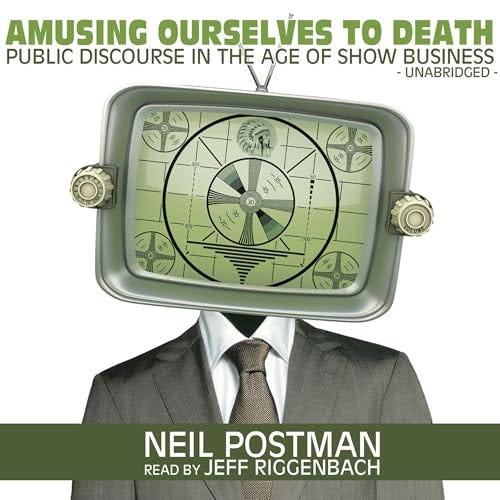
People know that reading is indicative of intellectual capability, and they want the social prestige without actually cultivating discipline, which is offensive to those who did so. This is prestige laundering, which we love doing in a society that’s forgotten how to think deeply, lulled into submission by convenience.
So read a book. If you really want to listen to them, fine — but don’t say you’re reading. You are listening to a podcast. If you actually want to absorb ideas on a deep level, you need to read the book. It is better for you to struggle with the text than to hear the contents, because the effort is the point, not the contents. People who collapse the distinction insist that because the content is the same, there is no difference in the act.
Next week, we’ll go deeper into the mechanism that led to this distinction collapsing, because it is simply a microcosm of a larger problem that Postman diagnosed at length: we can no longer think deeply or evaluate truth claims because our dominant media preclude what can be claimed as true. The typographic mind is nearly extinct, to our collective detriment. So if you read books, shout it from the rooftops. If you don’t, put your phone away and start. Intellect isn’t about credentials or the recitation of facts. You must wrestle with ideas if you’re going to claim intellectual ability.
I’m a music professor and I have to remind my students, over and over, about the difference between hearing and listening. It’s so easy to turn listening—a foreground activity—into hearing—a background activity—that we often don’t notice the change has happened. We’re biologically wired to “think less” with our ears than with other senses.
How often is someone who is “listening” to an audio book really only “hearing” it?
But, to the larger point, I am always saddened by how much we are all encouraged to eschew any/all friction. To me, the whole point of any intellectual activity (and most physical ones for that matter) is the slog. Working through something difficult *is* the point, not the “I finished” part.
To quote an album title from 1987: “Give Me Convenience Or Give Me Death.”
I've been listening to Postman 😅 and wondering about this. The net effect of quitting audio books would be that I consume far less written information. I don't engage deeply with everything I listen to, but not all of it is worth deep engagement.
Then again, when listening to The Prince, do I really want to embark on a deep dive into Renaissance geopolitics, or is it enough to skim across the surface in an effort to sample a classic while providing fodder for lateral thinking?
I spent the first 20 years of my life with no TV and developed a typographic mind. I also was clueless about how to communicate with my peers, and very narrowly informed. Still figuring out the best mix....