

The political dating filter: how educated women narrow their mate pool beyond reason

If you’re new here, I write about social control mechanisms and attempt to invert assumptions about group behavior, particularly my own. I also write about the evacuation of judgment and erosion of agency in social and professional contexts. I don’t spare myself in my analysis.
The man you marry must be liberal, or you’re an Usha Vance.1
There’s a specific kind of cognitive dissonance that comes from watching a woman of color who seemed to have been intellectually reared in progressive circles endear herself to this iteration of the Republican Party, so it’s no surprise that the main question being asked of Usha Vance has ended up: Is she actually a Republican, or what?
Slate, “The One Thing You Need to Know About Usha Vance,” July 29, 2024
If her noncompliance with the progressive ideological dating filter is fine, then everyone else made poor choices and may not have married the type of man they’re actually attracted to.
White and especially brown/Indian-American professional-class women hate Usha Vance and would rather pretend she doesn’t exist. Part of it is envy, and part is a desire to see her punished for marrying a man 1) they deem a low-status incel, given the mockery, and 2) who has power despite that low status among the denizens of the left internet.
But more than all that, Usha wasn’t a good liberal Indian-American girl and didn’t pick a liberal/feminist white guy. That is the sin, because that filter is as mandatory among this class of women as the education filter. Education, ideology, and height—maybe not in that order. Those are the filters. The one we police each other for the most, however, is ideology. Usha seems to have divergent views from her husband and doesn’t seem to be a submissive, secretly conservative handmaiden. She remains Hindu, which to me looks like a sort of resistance to Republican expectations. She also brushes off questions about their difference in faith.
The first result of these filters is a narrow pool of men for both white and brown women, who make up the bulk of this class. The ideological filter, however, is less recognized. The requirement that a good feminist marry a sufficiently liberal/progressive man not only leaves an even narrower pool, but also leads to potentially unhappy marriages, as women falsify their preferences to remain in good standing socially with other women. They may not even realize all this.
The first time, I applied the progressive filter and ended up with someone I ultimately found unattractive because of the feminized behavior often found among men with those politics. This showed up as a lack of self-concept, risk aversion, conflict avoidance, and discipline.
In general, partners are a type of status marker. For men, attractive women garner social capital among both men and women. Women, however, gather social capital from many sources, but mate choice is essential. Women need their friends to approve of the man for their own social standing, as they need their families’ approval.
As part of the smaller subset of professional women, I’ve noticed Indian American women in particular both disdain the opinions of white women but nevertheless want to ensure that none of their brown or white female friends see their spouse as problematic. I know this is a case of preference falsification based on how often women, especially brown women, fret around me about the ‘conservative’ ideological leanings of the men they date. It’s among the top three attributes discussed, and it frequently results in the man being excised. Conservative is often just to the right of the left end of the spectrum. Moderates need not apply, since they are conservatives in disguise. One will risk a professed progressive who turns out to be opportunistic rather than a professed moderate or conservative who, at least, is what he claims to be.
Progressive credentialed women often take a single social opinion and extrapolate the man’s moral character as wanting. The subject is usually regarding a vote for Trump or support for anything he did, or even without those, insufficient deference to gender ideology. The latter is still the third rail of American social life. There has not been a vibe shift like people seem to think.
The ideological filter, however, is only the top layer. The substrate is the moral arbitrage of mate choice among women, which ensures compliance with the filter. The filter’s enforcement functions as a mechanism of competitive suppression for professional-class women, whether conscious or not. If there’s a large portion of the already small professional class pool of men that’s off-limits, then fewer women get the status benefit from marrying such a man. But a third layer is also the shame associated with wanting masculinity at all, and its ridiculous association with the right.
Choosing such a man is a sin among many liberal and nonreligious professional-class women. It’s not really about ideology, but about suppressing competition. Call it reductionist if you will, but there’s plenty of evidence for competitive suppression among women in terms of mate choice, about which I have written before. What is intriguing about this group is that roughly equal proportions of millennial women and men are politically moderate, though this is aggregated nationally rather than disaggregated by the urban/rural divide. I suspect my own sample size reflects a more progressive woman on average than most. Separately, Gen Z women tend to be more liberal than men in that cohort.2 Gallup uses a national sample but doesn’t tabulate by educational status or gender, whereas Pew’s analysis found a large gap.3
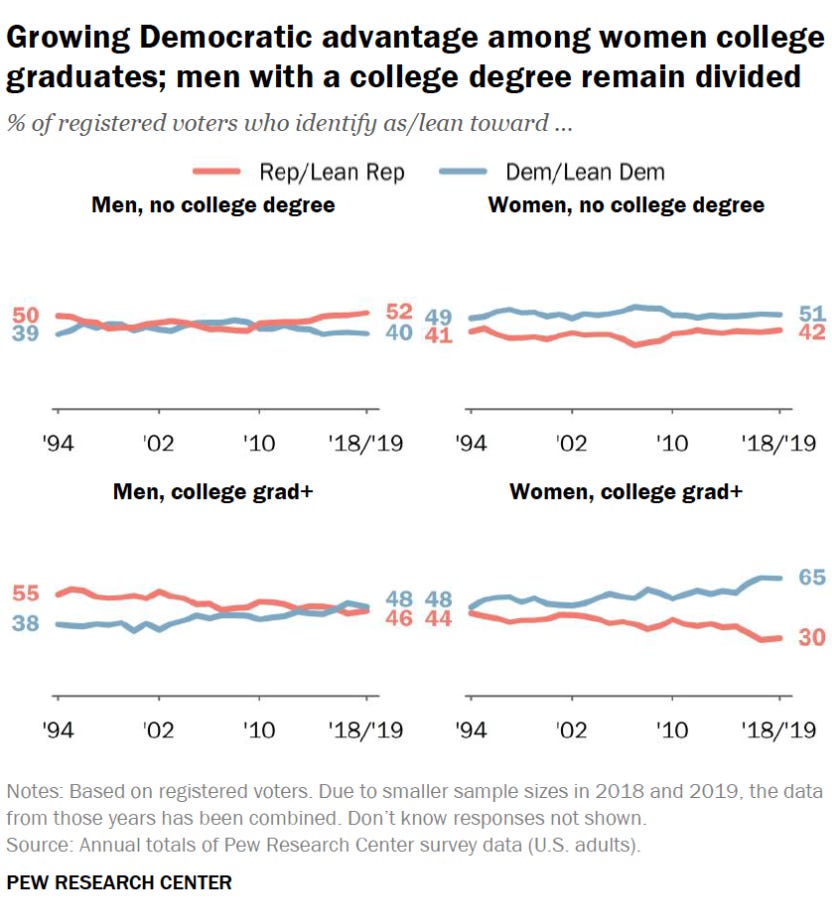


At the same time, I often hear progressive women say some variant of “I need a man to contain my chaos” with straight faces. So they want a masculine structure for their feminine entropy, which correlates with, you know, masculine men of a particular kind. Here, I’m not referring to dominance in the abstract, but the capacity to hold a line, indicate steadiness of temperament, and reliability. The concept of “I want him to be my rock.” These traits can coexist with kindness and prosocial behavior, leaving room for men who might be socially dominant without being aggressive. I can’t read the Vances from afar, but I do know the progressive filter can often select for the opposite type of man—a conflict-averse, socially anxious type.

And look, entropy isn’t a moral flaw, but rejecting men who would contain it because they have the wrong opinions costs women potentially happy marriages.
