

Why most software is shit: benign racism, hierarchy, and H-1Bs
Managerial capital and Hindu upper caste culture are symbiotic

I wrote last about how the H-1B system incentivizes treating workers badly, hiring cheaper and less skilled labor despite the stated justification for the visa, and that the debate about them is falsely done within the racial frame that’s the default for the managerial class.
The H1B system betrays the luxury beliefs of the professional class

The defense of high-skilled immigration is one such example of class interests dressed up as moral righteousness.
No doubt I will get comments about “not all Indians” or “not all men.” I remind those people that patterns need not describe every individual in that category, but nevertheless, should be examined. The objection to pattern recognition writ large is related to an assault on the judgment of the individual. We are not allowed to draw conclusions from anything other than an institutionally produced study, but individual human judgment is the basis of our civilization. Even as LLMs continue to erode it, we are allowed to assert falsifiable conclusions based on observation. Furthermore, no one is going to study what I discuss here because it’s born of experience, not outside observation in a laboratory. These phenomena cannot even be captured in a lab because of the social desirability bias in sociological research.
The question about high-skilled immigration isn’t about race but about the behaviors born of class and culture, of which caste is a component in the case of Indians. Using the race frame is intellectually lazy and betrays a lack of sophistication in understanding the Indian diaspora. Nor do I believe outsiders are capable of accurately evaluating the effect of Indian culture on global managerial capitalism because they cannot see what people with my vantage point can see. Similarly, the experience of one’s own cultural group will reveal that which outsiders can’t see.
We don’t expect surgeons to take the opinions of the untrained, so why would my firsthand experience in these environments not be more instructive than the observations of pundits at a distance? Because while we are absolutely worshipful of expertise and have designed an undemocratic cult around it, we nevertheless implicitly think that the bourgeois chattering class has a special understanding of things that they have never observed firsthand. Anthropologists are expected to embed themselves in their communities of study, and participant observation is considered the gold standard of sociological inquiry. This may be done by an insider-outsider like me and is considered academically authoritative. I am an ethnographer of the Indian diaspora in America.
I argued that H-1Bs are essentially indentured servitude that both naturalized Indians and managerial class whites have an interest in perpetuating, while shutting down discussion by calling it racist. Ironically, even people like Richard Hanania came after me to say “racists were cheering me on.”
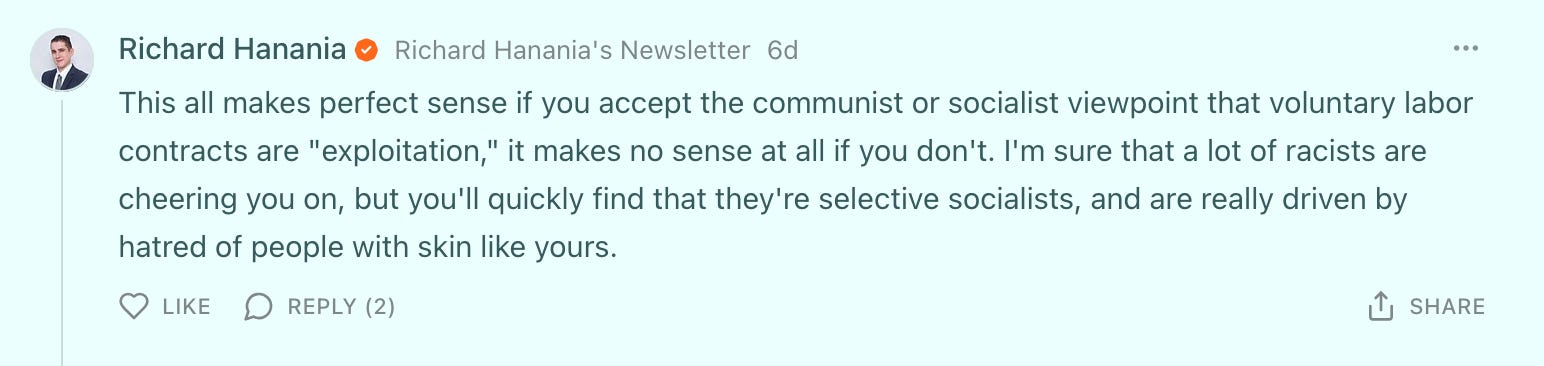
This is a projection onto an Indian-American woman who’s actually studied the diaspora and Indic philosophy and who works in a technical field dominated by Indians, not to mention my participant observation of Indian social life in the U.S. and experience studying in India.
Hanania’s move above is also the default knowledge-suppression mechanism of the managerial class, regardless of ideology: whatever could be misused by immoral people must be suppressed. I will take this up at the bottom, but Hanania's comment in part inspired this examination of what is produced under these working conditions: poor software that doesn’t last and waste on a grand scale.
i. Software quality is downstream of epistemic conditions
The purported scarcity of the technical skills that justify H-1B visas is no longer a tenable argument, and virtually no writing on this topic seems to wrestle with this inconvenient fact. As the cost of writing code has become close to nothing (other than water, of course), the case cannot be made with a straight face that H-1Bs supply any skills that are scarce.1 Executives keep insisting that people must upskill, and so native workers are truly on an even footing with H-1B holders.
This is a moment in which companies have made LLMs the solution to all their problems, but they will regret it. Regardless, we simply need far fewer engineers with good judgment than we need wrench turners who write code. In software development, there are the people who execute rote tasks that arguably involve little high-level thought, the actually good engineers with judgment who can architect and build software, and the product managers who work with the rest of the company and customers to figure out which problem to solve. We no longer need wrench turners; thus, the entire junior stratum of developers produced by computer engineering degree farms is unnecessary. This argument implicates both the credentialing apparatus and the commentariat in their bad-faith arguments.
I’ve said before that judgment is the scarcest skill and yet the least valued because it creates friction in a society that runs on perception management, where compliance is the expectation, not critical thought. The pre-existing macro conditions for managerial capital are unsuited to software development, which requires productive friction to reach the correct answer, not just the politically acceptable one. Academics like Adam Grant write books about why companies need non-conformists, but in practice, companies don’t actually reward those people and often push them out (speaking from experience).
We stopped judging and handed agency to the machine

The following is an extrapolation of a pattern from all that work about the conditions of knowledge production that actually suppress our innate faculties. These observations have come from the experience of writing publicly, from implementing LLMs for businesses, and from my own social context in the professional class in Austin.
There are many wrong ways to build features and platforms, and a few elegant paths. This requires judgment, not writing code. The ability to build software is downstream of logical reasoning skills; coding languages aren’t the skill. The pattern recognition that leads engineers to know which frameworks are suitable for which portion of the stack is the actual skill. Programming languages are merely syntax; similarly, people who are gifted at language acquisition can learn several languages because the true skill is pattern recognition.
Most software is subpar and doesn’t last long precisely because the default conditions of managerial capitalism are to enforce compliance rather than to build the best product. The product’s quality is often the last consideration after sales and internal process overhead.
The need for project managers is another factor contributing to the degradation of software development, and an unacceptable number of project managers are H-1B visa holders. It is not justified to hire labor at depressed wages and incentivize compliance with jobs that involve judgment about what actually requires a process and what is process theater.
Much of the software is mediocre or non-functional, not least because executives are constantly anxious about development speed and don’t appreciate the complexity of what they sold without having built it. This leaves engineers to absorb the anxiety from above, with project managers as the conduit. PMs exist for process theater, not to actually move things forward. The procedural overhead itself creates more nodes of enforcement, such that by the time the engineer works on a feature, the possibilities for what can exist have been reduced to what can be delivered in two weeks with minimal friction, not what is best to deliver technically or what the customer even needs. That’s because process theater puts the true customer need last.
The shortcuts companies take during the development process create technical debt, which kills value and efficiency. Yet, companies would usually rather spend money on something new than fix the problem at the root, especially those that sell software. If something as pesky as technical debt could kill a deal, we pretend not to see it or otherwise assume someone will deal with it eventually. But most people don’t consider technical debt worth the political cost, so it’s never fixed.
Product managers on H-1Bs also face executive pressure that cascades down to engineers, leading to difficult technical trade-offs to meet often unrealistic deadlines, which I’ve experienced repeatedly. When I worked for Indians, I was implicitly required to acquiesce and pressure engineers to work basically around the clock to deliver something sold without product discovery, under an unrealistic deadline that no one wanted to move because of… anxiety.
In my technical consulting roles, I am constantly pressured to deliver something the customer may not actually need, but what was in the contract, rather than what would solve their problem. I generally refuse, and that’s why process people particularly hate me. I’ve had issues with almost all project managers I’ve had because they care far more about appearing to follow a process than about doing the work efficiently, and many of them being H-1Bs means they’re also afraid of losing their jobs, in addition to the engineers who are already anxious about the same.
So much of software development happens under conditions of inefficiency, anxiety, and unrealistic expectations. Add H-1B restrictions of staying employed at the company sponsoring you, and you get a recipe for so much corporate waste it would make your head explode. Most software is shit, and most businesses are simply wasting money on it because the people who make it lack the judgment to know what to build and how quickly it can be done, and customers lack the judgment to evaluate who’s bullshitting and who has a real product. It’s extremely common for companies to sell software they haven’t built yet based on lightweight prototypes, which leads to an underestimation of the complexity of the back end, the data structures, and processes that move data. And yes, sometimes this is necessary at a startup or with a new product, but it’s still a bad practice in principle to base a deadline and set customer expectations on a prototype.
The anxiety everyone feels is produced by a fear-based environment, which means most people suppress their judgment about what should happen to what will get people off their backs.
Software quality is downstream of working conditions, which are downstream of epistemic conditions. The same epistemic closure and lack of judgment that produce a therapeutic-managerial-corporate society also produce bad software. Software that’s produced under a regime of fear and anxiety reflects the emotional state of those who build it.
Where managers once dictated discrete tasks to wrench turners on the factory floor, shitty software is produced by many companies that don’t deserve to be in business because of their product quality. Yet they are because there will always be enough H-1Bs they can underpay to create subpar software, make millions, and move on to the next company that gets run into the ground under the same conditions.
This is because H-1B visas don’t set an income floor based on the job's difficulty or the worker’s skills, but rather on the worker’s fear of returning to India, where they would earn far less. The floor is actually the minimum salary for an equivalent job in India. The soul-crushing H-1B job here will almost always be preferable to going back. I’m pulling this line of thought from Frank Lee:
I think the explanation is the tendency of people to measure their status to those they consider their peers... really a flaw with respect to rational behavior. Immigrants are using the peer group of their home country and are willing to accept lower wages because they are still making significantly more than that peer group. Domestic labor is not willing to accept lower wages because it puts them too far beneath their domestic peer group.
I don’t blame them, but this creates the structural conditions in which too many workers must suppress their judgment to remain employed, resulting in enormous waste. But of course, this waste is also in the interest of supporting far more white-collar jobs than the work would justify. H-1Bs are part of a larger jobs program for the credentialed class that Graeber diagnosed in Bullshit Jobs, because they provide the lifestyle of leisure that Veblen wrote of in Theory of the Leisure Class and that Galbraith, in The Affluent Society, located in the imperative to sell products at a predictable pace to ensure efficiency. In the name of said efficiency, we get bad products that don’t last.
ii. Hindu culture enforces deference and hierarchy
Something invisible to white people in particular is the deference and compliance expected in Hindu culture, especially because India is still a hierarchical and patriarchal society writ large. Duty, loyalty, and filial piety are the ordering mechanisms, as I speak from experience living in India and observing people across diverse occupations. Most Indians in the U.S., and especially in the corporate world, are Brahmins.2
There is a special deference to Brahmins expected from the lower castes, though Brahmins in the U.S. will hate me for saying this; the caste system is not only a social fact but also a source of shame in a more mobile society like this. Hindus in the U.S. know deep down that ideas about Brahmin purity and superiority don’t square with the American ethos that at least pays lip service to equality, and they know how bourgeois whites might react to this social fact. This is why Hindus in the diaspora are mostly silent about this and consider me to be airing dirty laundry.
H-1Bs who were hired by Indians in particular are very likely to feel a sense of loyalty because their presence in the U.S. and hope for a better life are tied to the boss’s favor. Add to this an already hierarchical culture, and you get a recipe for compliance.
Native-born technical workers are much more likely to be motivated by the craft because they can stick to principles. This is because they are not tied to their jobs like H-1Bs and can therefore simply absorb more risk in their careers. I’ve written before that women often struggle in their careers because we tend to be more risk-averse, a result of incentive-and-trade-off calculations. The H-1B system encourages low risk tolerance, so principles of the craft are often sacrificed.
iii. The sexism factor: Indian men and managerial capitalism
~70% of H-1B recipients are from India, and among them, 76% are men.3 People bring their culture with them from their countries, as evidenced by most Indian immigrants, who still adhere to these customs within their extended families. Individualism externally, deference domestically.
On top of this, Indian women are particularly expected to behave compliantly at home and work, while sons are treated like kings and given every freedom. Can’t rock the boat. Indian women are in a particular bind because not only are we expected to perform highly because of positive stereotypes, but we’re also not supposed to be too assertive or direct at work.
This is where Kimberlé Crenshaw’s legal framework of intersectionality lays out what happens to those with more than one identity, like Indian-origin women who experience the compounding effects of sexism and a sort of benign bourgeois racism that expects our obedience. Even worse is when this comes from Indian men, and we can’t even name it without inviting ire. American corporate culture already requires someone like me to be painstakingly indirect in my communication. Add Indian cultural expectations, and I might as well become invisible to survive.
This is why Hindu culture in particular is extremely well suited to managerial capitalism. The behavior required in corporate environments is even more visible and enforced among Hindus because we come from a hierarchical culture.
No one leaves the cultural mores they’ve grown up with outside the workplace as though it’s a blank slate. Indian cultural norms in particular are influential in corporate life, but they’re invisible because DEI doesn’t have language for this. Nor are credentialed white people willing to emerge from the quagmire of moral relativism, which prohibits the honest evaluation of non-white cultures.
Indians are considered smart and hardworking, but not all of us actually are — among a billion Indians, we cannot possibly assert that everyone who ends up here deserves it on the basis of cognitive ability and work ethic. And we’re not good people automatically just because we’re brown, which is an example of the black/white racial binary at work, in which blacks are perpetual victims with exalted moral status due to white guilt. This is paternalistic racism.
If we accept that Indian culture is still hierarchical and patriarchal, then we can reasonably assume that Indians bring this culture with them to work. Indian-American women like myself are routinely subjected to this Indian-origin compliance culture not only at home but at work, and this is why, frankly, I generally refuse to work for Indian-origin men. If I had to choose between a white man and one from India, I would always choose the white man because the chances of being punished for my personality are far lower. That is not to say white men haven’t also tried to hold me back, but one makes calculations based on patterns. This is the application of judgment based on repeated instances of the same thing (you know, patterns), though I’m sure a non-zero amount of you will somehow consider it racist to calculate that men from my own patriarchal ancestral culture will not treat me well.
If you ask Indian-origin women about this, they may or may not be honest because they have an interest in protecting the perception of their home culture. But Indian-American women almost universally tell me they’ve been treated badly at work by Indian-origin men. This is because our personalities are American, in that we value individualism and often resent expectations to comply with cultural imperatives, particularly those imposed by Indian men. Feminism had a singular use for me in early life: to resist Indian patriarchy.
The more independent and assertive a woman, the more likely she is to be targeted. I don’t know how white women feel about this, but my guess is their experience is similar because patriarchy doesn’t discriminate by race. This is another instance in which the white guilt framework of DEI intentionally overlooks intersectional oppression because it requires judgment about group behavior and cultural tendencies. White people straight up refuse to do it, and women, ironically, suffer because sexist behavior is invisible when it doesn’t come from white men.
The effect of all this on the software is degradation of quality because of invisible social control mechanisms and enforced compliance among Indians with each other and from Indian (mostly) men downward. Just as the conditions are created to incentivize compliance among H-1Bs by naturalized Indians, that enforcement flows to American-born people and from men to women. We already know that Indian work culture is notoriously even worse than American — they work ten-hour days, six days a week. Add to that the need to manage perceptions, and you get predictable, dysfunctional workplaces with horrible cultures, papered over by slogans about corporate values. Not only are wages dampened by the availability of ample cheap labor, but the conditions are created for worker misery that’s laterally and vertically enforced. And there’s no framework to improve it because it can’t be named.
iv. The racism factor: white paternalism
Finally, we reach some of the feedback I received on the last installment, particularly from Richard Hanania. Because I take my critics seriously, I’ll respond to each sentence.
This all makes perfect sense if you accept the communist or socialist viewpoint that voluntary labor contracts are "exploitation," it makes no sense at all if you don't. I'm sure that a lot of racists are cheering you on, but you'll quickly find that they're selective socialists, and are really driven by hatred of people with skin like yours.
The first sentence misunderstands what exploitation can be. Our society is not openly coercive, but nevertheless has many structures that are coercive in effect for the people around those who ‘voluntarily’ enter these contracts. H-1B-holding Indians don’t see themselves as exploited, not least because Indian work culture is far worse than American, but also because their floor is going back to India to make less money under worse conditions. Anything will seem better than that. It’s not communist to observe that when a group of people who are dependent on employers for their families’ staying in America volunteers for something that makes their absolute conditions better, the mere fact of their indentured status affects everyone around them who are also forced to participate in the race to the bottom.
Floors inevitably erode the conditions of whatever they’re applied to, and you’d think a libertarian like Hanania would understand that. Indians not seeing this as exploitation and doing it voluntarily does not change the fact that, relative to conditions in which H-1Bs did not exist, conditions for native workers degrade and become exploitative by default, as they did for me. The difference is that native-born workers have options, so they are unlikely to stay long-term because they care more about the craft and quality of life than about keeping the job. Actual critical thinkers, not incentivized to comply, leave companies, which leads to a degradation of the product. The company ends up having a majority H-1B population, as I saw in my experience as a product manager.
The second sentence in which I am warned about “racists cheering” me on is truly breathtaking in its assumptions. First, the implication is that writing about any topic that might give apparently bad people ammunition for further impure thoughts means the ideas must be suppressed. This is one of the most morally detestable positions that institutionally affiliated people take, because it makes knowledge contingent on their approval, particularly for topics about which they know little. Hanania is such a person because he’s never worked in an environment with H-1Bs. This position that knowledge can be dangerous is totalitarian, and it’s a function of class rather than ideology, unlike what I once thought. I was mistaken in assuming that this utter disrespect of knowledge in general was limited to the institutional left.
Credentialed people without firsthand experience in corporate America seem to comment on its conditions with remarkable confidence, though they would otherwise tell regular people that we’re not allowed to use our judgment because they’re the holders of all knowledge. I refuse to subvert my judgment just because some people with whom I don’t agree will take my positions as agreement with theirs. I can’t control what other people do with what I say, but it’s still my duty as a writer to say it. Once we accept the position that some knowledge is dangerous, we cede all knowledge to potential suppression.
Secondly, I don’t believe that all people who criticize the H-1B system do it because they hate brown skin. That’s a facile and cartoonish description of how racism works today. And even if I grant that they are racist in this simplistic manner, the paternalistic racism of credentialed white people will always affect me far more than the type of open racism those same people want to distance themselves from. I would rather deal with an open racist than with institutionally affiliated whites, because at least the former is honest. The latter are wearing a costume of morality while hiding classism and racism.
v. Conclusion: the need for occupational diversity
I’ve thought for some time that Indian-Hindu culture is well suited to the managerial-capitalist system, which requires the suppression of directness, assertiveness, and individualism, and is less concerned with the concrete and more obsessed with perception. Despite this, I think we should allow more Indians to immigrate because they have more children, are entrepreneurial and open small businesses, and are amenable to democracy, unlike the Chinese, even if imperfectly.
If our primary rival is China and we are also experiencing population decline, we need more workers to create jobs outside the managerial state. The Indian diaspora’s earlier waves were far more occupationally diverse, which created a rich culture that seems hollowed out these days. This is partly because of the internet flattening all culture, but also because the only Indians we import now are in a single sector. This is also no small reason why cities like Austin have very little good Indian food. No Indian immigrant is moving here to open a restaurant like my parents did in Florida in the 90s.
As I mentioned in the previous installment, the anti-Indian sentiment online isn’t directed toward small business owners but toward credentialed Indians like Vivek Ramaswamy, who insist on a single interpretation of Indian culture focused on work at the expense of all else. America is culturally richer for the Hindus settled here, not to mention what Hinduism has contributed to bourgeois white culture that’s become a whole sector on which white women base their livelihoods: wellness culture.
I am not universally against skilled immigration, such as for hardware engineering, where skills are truly scarce. But the system today is indefensible because it leads to waste, fails to attract the best and brightest, and worsens working conditions in an already hypercapitalist society.
I write about systems of social control and don’t belong to a tribe. This makes me algorithmically unfriendly. If this revealed something you noticed but didn’t have words for, I ask for your support in spreading my work by sharing or becoming a paid subscriber.
Experience in product management and software implementations has shown me diverse engineering environments. The general assumptions about how ‘software engineering’ works are informed by the relatively ideal environments of consumer-facing brands that began as web apps. Google and Facebook make their own hardware, and the companies that make physical things are far more valuable than consumer-facing apps, like NVIDIA compared to Netflix.
The point is that describing something as a ‘tech company’ flattens the diversity of functions that those in the category of ‘engineer’ do, as well as flattens an unfathomable range of possible functions that would all fall under the vague and fetishized title like software engineer or architect. The following considerations are part of the taxonomy of careers that are called technical:
Is your customer a consumer or a business?
Does the company make physical and/or software products?
Do you actually work on the software yourself, or are you in an adjacent position in a company that makes software? Marketing, sales, and related roles are required for companies in the ‘tech’ category, but these jobs don’t require technical skills. Those are, therefore, traditional jobs in companies that make software, not ‘tech jobs’. Precision matters because social capital is attached to whether one can say they work in tech.
Do you create software, or do you help businesses use software others made?
Do you have to care about the system around the thing you’re working on? These people are architects, not developers, though both get lumped into ‘engineer’.
This is the more complex view of ‘software engineering’ beyond what the news tells us about the companies with the largest market caps. Despite this, most software is produced under deplorable conditions.
See The Other One Percent: Indians in America for more on the statistics.
“Characteristics of H-1B Specialty Occupation Workers,” US Customs and Immigration Service, 14.
Really appreciated hearing from someone with first-hand experience on this topic. And, I appreciate your defense. Just because Hanania used to be a racist, I guess he believes everyone sees the world through the same lense. This isn't a lower class, uneducated problem. It is an entirely Brahmin issue and it's clear to me that it is exploitation.
I think a lot of the degradation of discourse today is the result of some wanting to see everything through a Marxian lens of oppressed/exploited-oppressor/exploiter, whether one has Marxist beliefs or not, and far beyond the realm of economics.
What follows from this is a victim class, one that cannot be questioned.
Marxism is the shitty philosophy that just won't die!
As I am beginning to explore on my Substack, a lot of this is really an accountability-of-authority issue. Things break down when authority becomes unaccountable.