

The H1B system betrays the luxury beliefs of the professional class
We've virtue-washed an exploitative system in progressive language

My project examines systems of control and exploitation imbued with moral valence. The defense of high-skilled immigration is one such example of class interests dressed up as moral righteousness.
What lies beneath ‘anti-Indian sentiment’
The hand-wringing about racism against Indians deserves to be excoriated. Over the last several months, we’ve seen claims that ‘anti-Indian sentiment’ is on the rise. It’s actually mostly about H-1Bs, not about Indians dominating hospitality and food franchises. We see the credentialed class, both Indians and whites, crowing about how it’s racist to be against H-1B immigration, how highly skilled immigrants create jobs, and that already privileged people being naturalized has no negative consequences.1 This is, straightforwardly, a luxury belief that serves professional-class interests. Rob Henderson provides a useful framework:
We also tend to decrease the value of beliefs held by others. We denigrate their views in order to bolster the relative value of our own beliefs. Furthermore, people often develop passionate beliefs about matters that are remote from their personal experiences. You’ll hear all kinds of ideas about, say, poverty from affluent people who have never had a twenty-minute conversation with someone who doesn’t have a bachelor’s degree.
Interestingly enough, the commentary from Indian-origin people is often from progressives who aren’t even in the areas for which H-1Bs purportedly solve a labor shortage. They’re also often American-born people, meaning the argument in favor of H-1Bs they make functions as a luxury belief from which they can draw moral capital by performing ‘racial’ solidarity with a group that doesn’t even consider them to be Indian.2 Indian immigrants, in this case, are essentially props for credentialed progressive Americans of Indian parentage.
This particular trend of online anger against Indians is against the credentialed variety. It’s not actually about race, but about the exploitative nature of the H-1B system. H-1Bs have become associated with a particular ethnic group, which white people and credentialed Indians automatically map to race. Because the people on the receiving end are brown, both Indians and progressive whites have an interest in using the standard racism frame. But H-1B visas are fundamentally a form of labor arbitrage that drives down wages and erodes security. They’re a form of indentured servitude that erodes working conditions for American-born workers of all ethnicities in the professional class.
I once worked for a naturalized Indian-controlled organization. All the engineering teams were composed of H-1 B workers, save for me and another American-born Indian gay man. I noticed that the H-1B Indians were all far more deferential than I, because they had to be. Naturalized Indians are actually some of the most brutal exploiters of H-1Bs, and no one notices because the DEI framework is myopically concerned with black/white relations. It has no language for intra-group discrimination based on immigration status. This company acquired an all-white data engineering team, and I became their product manager. We all acted differently from the H-1Bs, and I was considered a traitor because I defended the white guys who were being exploited along with myself. We all eventually left because we didn’t have to tolerate it. There was one month at that company when I worked every single day.
Working conditions were horrendous for everyone because the H-1B workers could be exploited without consequence, and the resisting Americans got pushed out by naturalized Indians. But this has no place in what passes as discourse about labor exploitation. We have no language for it because we can’t imagine white men as victims, nor can we imagine that people with melanin would also be exploitative toward their ‘own people’. But this is about class solidarity, not ethnic or racial association. There’s a hierarchy in the diaspora: a combination of immigration status, caste, and credentials determines one’s standing.

How American-born Indians benefit from labor exploitation
Indians being willing participants doesn't mean the system is morally righteous and defensible. No one has the right to emigrate to a country to make more money. It’s fine if they want to and the country allows it, but cloaking anti-competitive systems in moral language is how the professional class captured most of the wealth in the first place.
I’ve seen this defense from Indian immigrants and from American-born Indians, and they’re incorrect because they have their own class interests to defend. Global mobility of labor is a fundamentally libertarian concept, adjacent to open borders, which is exactly what the wealthiest want to retain control over a distributed labor force for American corporations. The left, in theory, should be against this. Bernie Sanders memorably told baby-faced Ezra Klein that open borders are a Koch Brothers proposal, to great sneering about xenophobia.
If American-born Indians are actually honest with themselves, they’re supporting a form of classist, credentialist capture that they also perform by moving in elite American institutions.
This performance of solidarity on behalf of H-1B Indians by racializing the issue also inoculates them against the argument of being white adjacent that white people deploy to great effect, preying on our existing familial guilt without us realizing. This argument in favor of H-1Bs is in part about white anxiety and how American-born Indians manage it.
Progressive credentialed Indians and whites are in the odd position of defending exploitative labor practices and resource hoarding by corporations even as they crow about ‘late capitalism.’3 Nothing the credentialed class defends is outside their material interest, and H-1Bs are no exception.
Universities with graduate engineering programs are also highly dependent on the exploitative system to justify charging international students full tuition. The system must be defended to ensure credentialing institutions can maintain these lucrative programs. Indians need a pathway to get a job with H-1B sponsorship, which usually means a master’s degree from a state university.
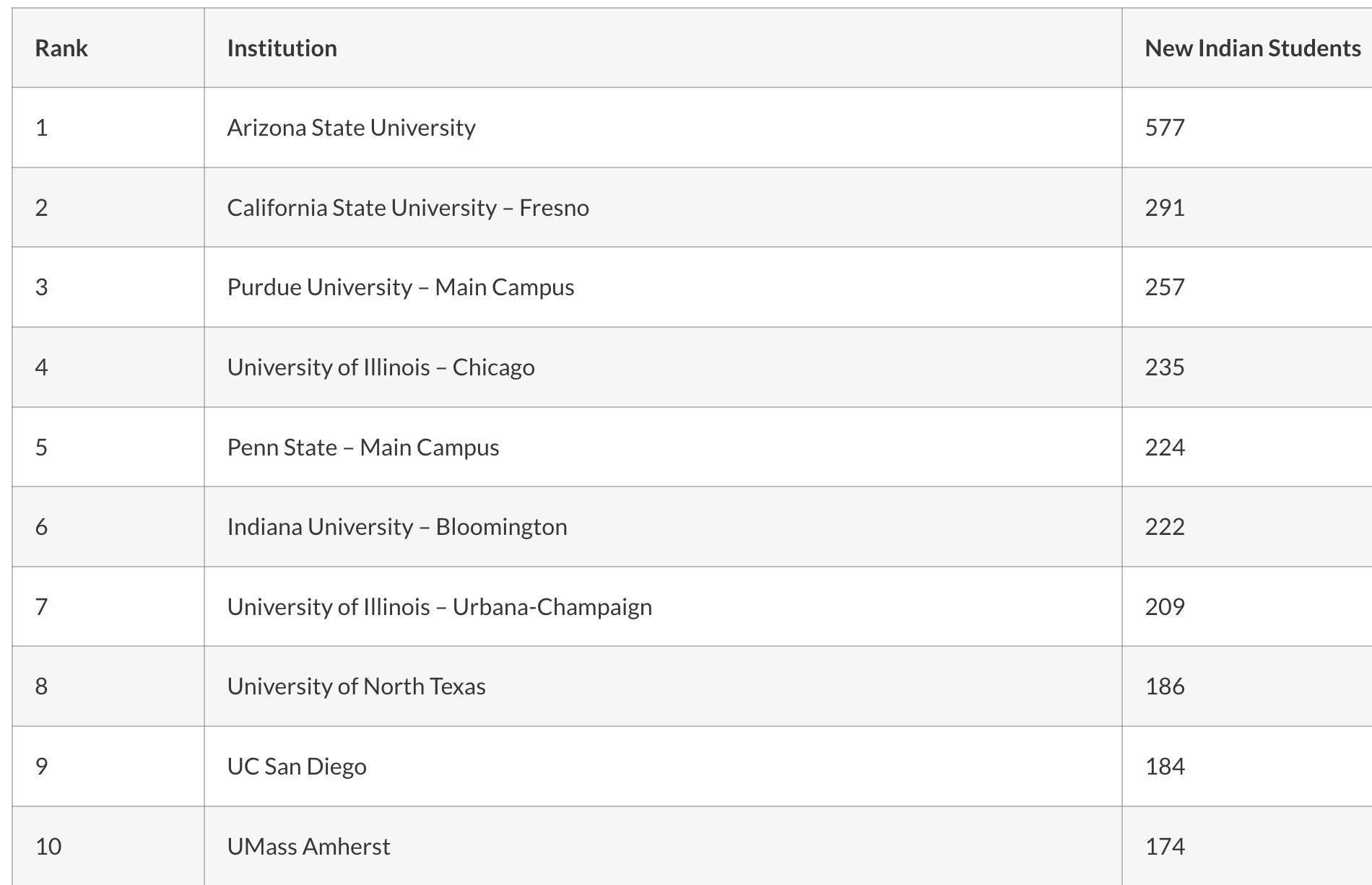
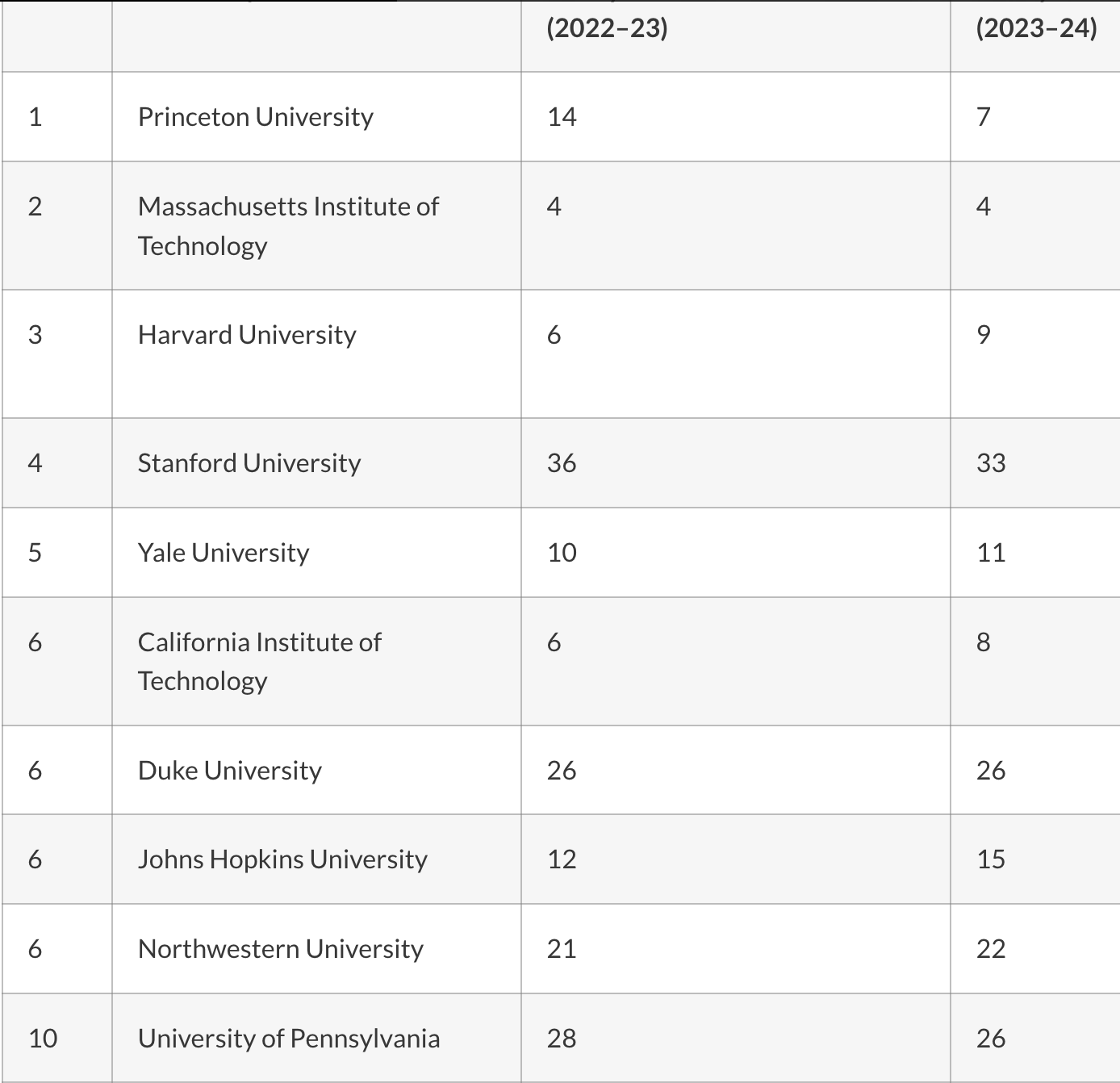
The loudest defenses often come from people in the credentialing apparatus that depends on the regulatory structure of skilled visas. The pipeline doesn’t run through elite universities attracting the best and brightest, as is often assumed. The universities enrolling the largest numbers of Indians also tend to be in states with few labor protections, often in the South, which further depresses wages. These institutions need Indian and Chinese students the most because of shrinking public funding, to boot.
What’s more, many workers who come via H-1B don’t have the scarce skills supposedly required. Americans like me with Indian parents tend to have similar credentials and skill sets, but we don’t have to brook mistreatment.
A significant share of H-1B visas go to project managers and recruiters who don’t have scarce skills, as I’ve observed while moving through Indian-dominated technical spaces for the past seven years. Those functions are currently oversupplied, especially with credentialed white women. Indian men are often displacing white women in reality, while we pretend that the actual problem is solved.
The majority of visas go to Indian IT consulting companies that Thomas Friedman once extolled in The World Is Flat: Wipro, Infosys, Tata Consultancy Services, Cognizant, and HCL Technologies. Social media creates the impression of a Google or Meta engineer, even though most visas go to these firms, which are the Wal-Mart of the consulting world.
Harvard Economist George Borjas found that H-1B holders earned 16 percent less than comparable natives.4 Another more damning paper reports:
Overall, our results are more supportive of the narrative about the effects of H1Bs on firms in which H-1Bs crowd out alternative workers, are paid less than the alternative workers whom they crowd out, and thus increase the firm’s profits despite no measurable effect on innovation. Prima facie, these results appear at odds with a chief goal of the program […] of providing firms with skilled workers who have unique, innovative skills that the firms cannot otherwise obtain. Even though firms attest that hiring the H-1B does not adversely affect similarly employed workers, our results raise the possibility that in many cases firms could be employing H-1Bs instead of employing other workers.5 (emphasis mine)
We’re allowing wage depression to hire more tech support, apparently:
Many H-1Bs are given for workers in firms like Infosys or Wipro that primarily offer outsourcing for temporary support services (often temporary technical support services). By contrast, other H-1Bs are given to companies like Intel or Google that do not specialize in such services.
The distribution of companies from federal government data shows that, among the top ten beneficiary firms, Infosys, Tata, and Cognizant received ~33% of visas, at 8,737, outnumbering Apple, Microsoft, Google, and Meta, which collectively received 8,163.6
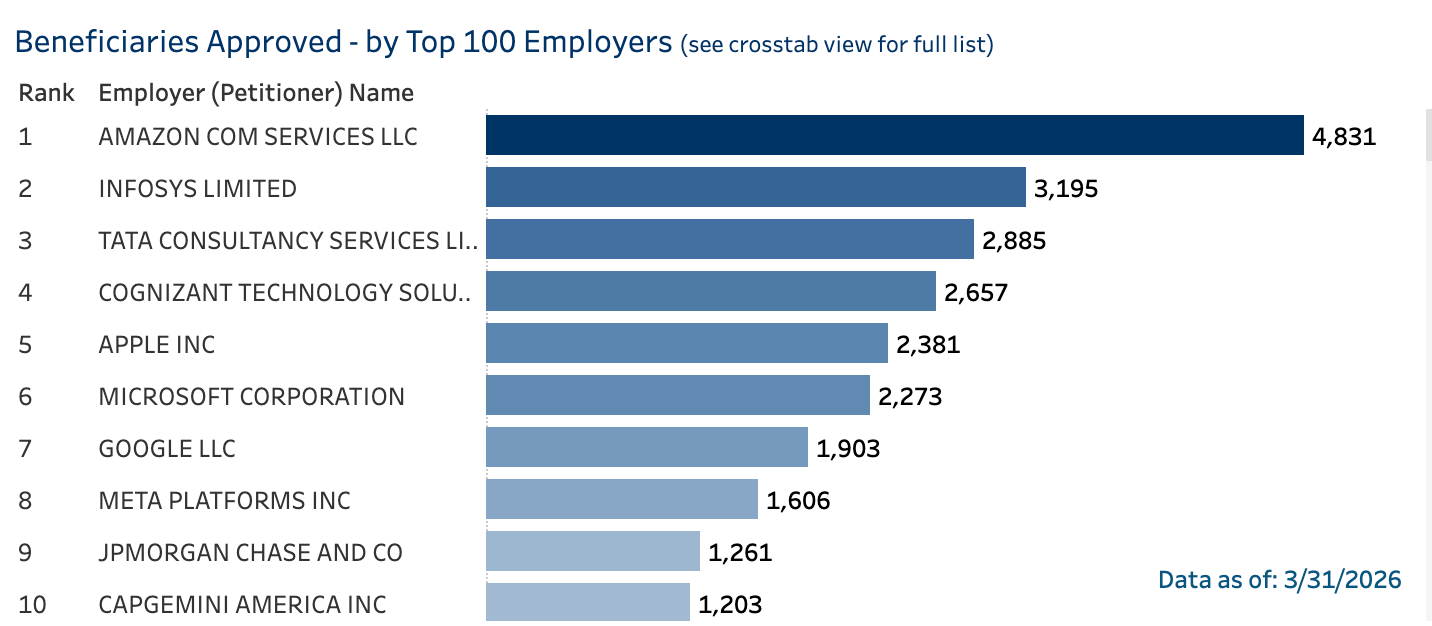
Even if I grant the skill-scarcity argument, 33% of visas go to firms that also sponsor recruiters and project managers, and any technical workers have skills that are obviated by Claude.
Melanin-as-a-Service: American-born Indians perform oppression for moral capital
American-born elite Indians love to emphasize the gender and race barriers they or their parents faced, and notably use that to paper over the inconvenient fact that their parents are also credentialed and came to America with social and material capital.
This is the same move managerial feminists make by obscuring the class position from which they demand power. Kamala Harris did this exact thing by omitting her mother’s elite background to emphasize her bootstrapping in America, despite living in Berkeley:
"My mother was 19 when she crossed the world alone, traveling from India to California with an unshakable dream," Harris said in her speech at the [DNC] convention. […] Harris says that despite her mother’s success, her life as a new immigrant was often marred by racism. “My mother was a brilliant 5-foot-tall brown woman with an accent,” Harris said in her speech. “As the eldest child, I saw how the world would sometimes treat her. But my mother never lost her cool.”
But no mention of how her mother was born into an elite Tamil Brahmin family, and her father was a high-ranking civil servant. To boot, Harris pretended to be from Oakland to perform class solidarity. But this isn’t even just about managing white perceptions. It’s also about justifying their own credentials and institutional membership with the requisite victim posture.
Anti-Indian sentiment from both the left and the right is actually about who’s winning the credentialism and asset acquisition game. The difference between the two is that the right is open about it while the left pretends it’s not anxious at all, using blacks and Latinos as justification for low standards. There are many diaspora working-class kids like me who used the system to climb above their parents’ station at great cost. Indians who own gas stations, motels and the like are also wealthy and have assets, but they’re invisible in a way the credentialed Indians at the top of the wealth distribution can’t be.7
A predictable objection is that I wouldn’t be here without the immigration system. I am a product of immigrants who came here separately via family reunification and a missionary visa. If they hadn’t come, I wouldn’t exist, which would be fine. My argument is independent of my personal situation. I also have skills comparable to those of many H-1B workers I’ve encountered, which I gained outside formal education. The difference is that I won’t defer. More importantly, I have more latitude to exercise judgment than those whose lifestyles depend on managerial approval.
In the next installment, I will examine the function of caste in this system, which is also obscured by Indians with progressive credentials using the racism charge as a deflection.
The conversation around H-1Bs obscures the luxury beliefs serving the class interests of naturalized Indians, American-born Indians, and progressive white elites. Supporting the system costs them nothing and accrues moral capital online. The stated reason for the belief is never the actual reason; the actual reason is revealed by who benefits from the exploitation. The obfuscation itself lays bare the indefensible nature of the system.
Part II:
Why most software is shit: benign racism, hierarchy, and H-1Bs

There are many wrong ways to build features and platforms, and a few elegant paths. This requires judgment, not writing code. The ability to build software is downstream of logical reasoning skills; coding languages aren’t the skill.
No algorithm brought you here, nor does it like me. If this made you think, please share/restack my work and consider joining the inner circle with a paid subscription, which is crucial to distribution for institutionally unaffiliated writers like me.
The authors of The Other One Percent: Indians in America show this in their definitive survey of diasporic class, caste, education, and migration patterns.
I’ve been polling them for years. The reason we’re not Indian is straightforward — we didn’t grow up there and don’t have the cultural context, and our parents’ conception of India is frozen in the 1970s.
This term has been evacuated of meaning.
George Borjas, “The H-1B Wage Gap, Visa Fees, and Employer Demand”, working paper, May 2026. I mentioned Harvard, by the way, for those who need institutional approval to believe a contrary opinion.
Doran, Gelber, and Isen, "The Effects of High-Skilled Immigration Policy on Firms: Evidence from Visa Lotteries," February 2016.
The owners of small businesses are primarily Gujarati, of the mercantile caste and the Patel sub-caste. Class and caste don’t map onto education among the diaspora, for a later essay. Credentialed Indians tend to be Telugu or Tamil and overwhelmingly Brahmin, though earlier waves of credentialed Indian immigrants were mostly North Indian. For more, consult The Other One Percent.
This lines up with my analysis. Immigration isn't a top issue for me, but it's obvious that exploitation happens both at the legal and illegal levels. A certain type of purported liberal-minded or libertarian-minded business class person wants to undercut wages, and immigration is the best tool for that. Not to mention, as you noted, immigrants tend to be more pliant as workers because they have to be.
I too don't see anything particularly progressive about trying to build a serf caste stateside. Especially not via black markets (illegal immigration and open boards), but increasingly not via legalizing predatory arrangements either.
I've seen this at startups. The visa holders were all yes men because they could be kicked back in minutes. Their managers loved them because, as you pointed out, they could be exploited.
I didn't understand until an Indian (US born) pointed it out. They H1B were worked like slaves.