

Listening still isn't reading - it's intellectual cosplay
No matter what Harvard or Amazon claim, effort matters

My argument about listening versus reading traveled further than expected, thanks to this note, and now I’m going to dismantle every counterargument on both that didn’t address my actual thesis: that reading encourages superior cognitive habits that compound because it requires more effort than listening.

If you read books and your friend listens to books and calls it reading, you’re going to have a superior set of cognitive habits that will get you further in life. There’s no study for this, but the logic would follow if you accept that reading is a more difficult activity than listening. None of the studies and arguments from Harvard and the like refute this argument.
I’m not talking about comprehension, so let’s get that out of the way. This is about the long-term effects and advantages of reading compared to largely passive intake of content via audio. I’m also not talking about whether you can write back what you heard or take a test on it; that is not the definition of intellectual ability, though the credentialed seem to think so.
To claim intellectual ability, you must be able to analyze and synthesize ideas and concepts, not merely absorb and regurgitate a narrative-driven book.
No doubt the fact that a woman (and Indian) is saying this will immediately piss several of you off. Be my guest.
Intellect has a definition, and without standards, it simply doesn’t exist. Maybe this is the true source of my rage about this particular topic — the people insisting the two acts are identical are implying that standards are immoral, and intellect isn’t tangible. Now, if your argument is that “everyone is differently smart”, then I have nothing for you. We’re at an impasse.
I’m not saying one should never listen to a book. But don’t call it reading. You are not reading. The act is distinct. Nor am I talking about the category of books that require following a story. I’m talking about books that center on ideas and abstract concepts.
The reaction is really about people feeling attacked by the implication that their habits are intellectually lazy, despite all the credentials they hold.
I am making an argument about behavior, not someone’s moral worth. Inevitably, I was called ableist and elitist several times by people who didn’t read carefully. If I were saying that people listening to books are morally inferior, then the charge would be warranted. If I had argued that truly cognitively disabled people who can’t read shouldn’t listen to books, then sure, I’d be ableist. But that’s a lazy charge that mostly white women who can read lobbed at me (minus one coconut-flavored Aakash) because it’s the only tool they have to shut down my argument.1
Those people are cosplaying intellectualism, wanting the disciplined identity without putting in the work. Discipline leads to substance, which is the foundation of a good life, which is yet another argument that I shouldn’t have to make. But the credentialed class, guardians of knowledge, hate being held to standards.
The most active people on Substack are likeliest to have degrees. Degree holders are likeliest to have time to read and, therefore, to have listened to the book for convenience while multitasking and commuting to their white-collar jobs.
These people could read the book and chose not to. Fine, listen to the book. But the two aren’t the same, and claiming otherwise is equating your laziness with my effort.
Perhaps the consternation underneath is that I’m making a judgment, and the credentialed find independent judgment so threatening that they outsource it to LLMs.

Intellectual laziness is justified by more intellectual laziness
I will first dismantle the various studies that were supposed to falsify my thesis. The most recent is from the Harvard Gazette. The load-bearing paragraphs:
Readers should reflect on their choices by focusing on the purpose of their reading, said Alessandra Seiter, community engagement librarian at the Harvard Kennedy School. Some might favor print text because it helps them absorb information better, and others might prefer audiobooks because they allow them to multitask and save time (emphasis mine).
There are clear practical implications, said Alex Hodges, director of the Monroe C. Gutman Library at the Graduate School of Education. Print texts offer readers the chance to highlight passages or write notes that might help them retain information better, Hodges said. Audiobooks, on the other hand, may impart a more relaxed experience.
Laura Sherriff, librarian for the Cabot Science, Fine Arts, and Lamont libraries, would like to remove the stigma around audiobooks. In her former life working at a bookstore, she saw kids starting out with “Harry Potter” audiobooks and coming back to buy the print books. “It was their gateway to reading,” she said.
They make my argument for me. Audiobooks allow one to multitask and save time, which can only mean that audiobooks require less attention and, therefore, are an inferior method for information absorption. The second passage admits audiobooks are a ‘more relaxed experience’, which can only imply that it’s easier than reading a book. Or, we need to argue about whether ‘relaxed’ means ‘less difficult.’ In that case, I have nothing for you either.
Finally, the line about Harry Potter suggests that audio can serve as a gateway to the more effortful activity of reading the actual book.
That Harvard Gazette article links to this NPR article, which centers on the claim that forty percent of Americans think listening doesn’t count as reading.
NEWELL: It’s older people over age 65, it’s men, and it’s those without a four-year degree that are more likely to say that listening to audiobooks isn’t a form of reading.
So they’re saying that the uncredentialed rubes who would have had to make time to read books are claiming their effort is superior to that of those who listen. And the addition of over 65 and men is the nail in the coffin of the argument — the person making the argument discredits it by the logic of credentialed white people.
There’s no data on this, but I bet there’s an ideological division, and that conservatives are likeliest to agree with me. But again, that would be used to discredit the argument without engaging it.
LIMBONG: All right, so that’s the polling, but what does the science say? Beth Rogowsky is a professor at Bloomsburg University of Pennsylvania who studies auditory and visual learning styles. In 2016, she co-authored a study of adults comparing comprehension rates between listening to an audiobook and reading on an e-reader, like a Kindle.
BETH ROGOWSKY: We found that there was no significant difference between reading a book using a Kindle or listening to a book or doing both - listening and reading simultaneously.
LIMBONG: In other words, participants retained pretty much the same amount of information whether they read a book or listened to it.
ROGOWSKY: Which is exciting news for people who join a book club but want to be able to fold laundry while they’re reading the book (emphasis mine).
Exciting news for those who want to socially justify taking shortcuts.
BUT THEN:
LIMBONG: There’s a big but here - the study was done using adults who knew how to read. Rogowsky’s done some further research looking at school-aged kids and learning styles and found that self-described auditory learners scored worse on comprehension rates across the board. That is, they did worse understanding and recalling information that they read and listened to (emphasis mine).
ROGOWSKY: That really leads you to believe that when you are learning to read, you really need to have the experience reading. When we tailor to a student’s learning style and we’re just giving them auditory formats, we are not reinforcing the reading skills that are so essential to becoming a proficient reader.
So, at the end of this conversation with Ari Shapiro, they’ve landed on the idea that children who can’t yet read need to wrestle with the book to comprehend it, and that listening yields inferior comprehension.
Now, let’s consider this study funded by fucking Audible on which Rogowsky, quoted above, is the first author.2 This is a press release with footnotes disguised as rigor to launder intellectual laziness.
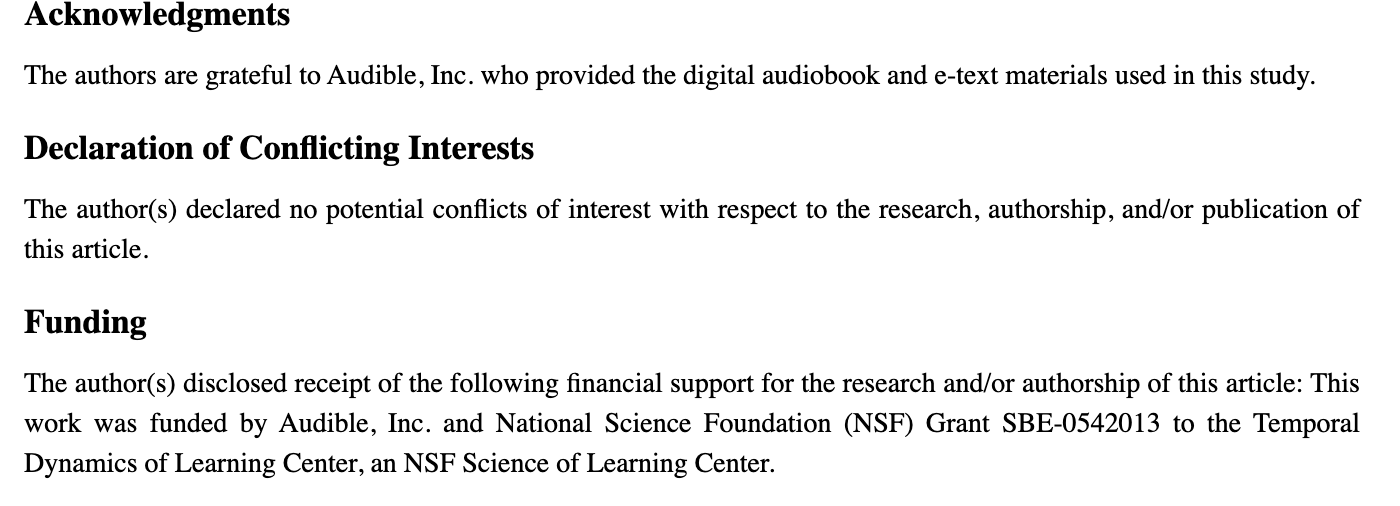
No conflicts of interest, apparently.
This study has been cited 121 times in academic papers, and who knows how many times by people wanting desperately to believe that reading and listening are the same. No such comfort.
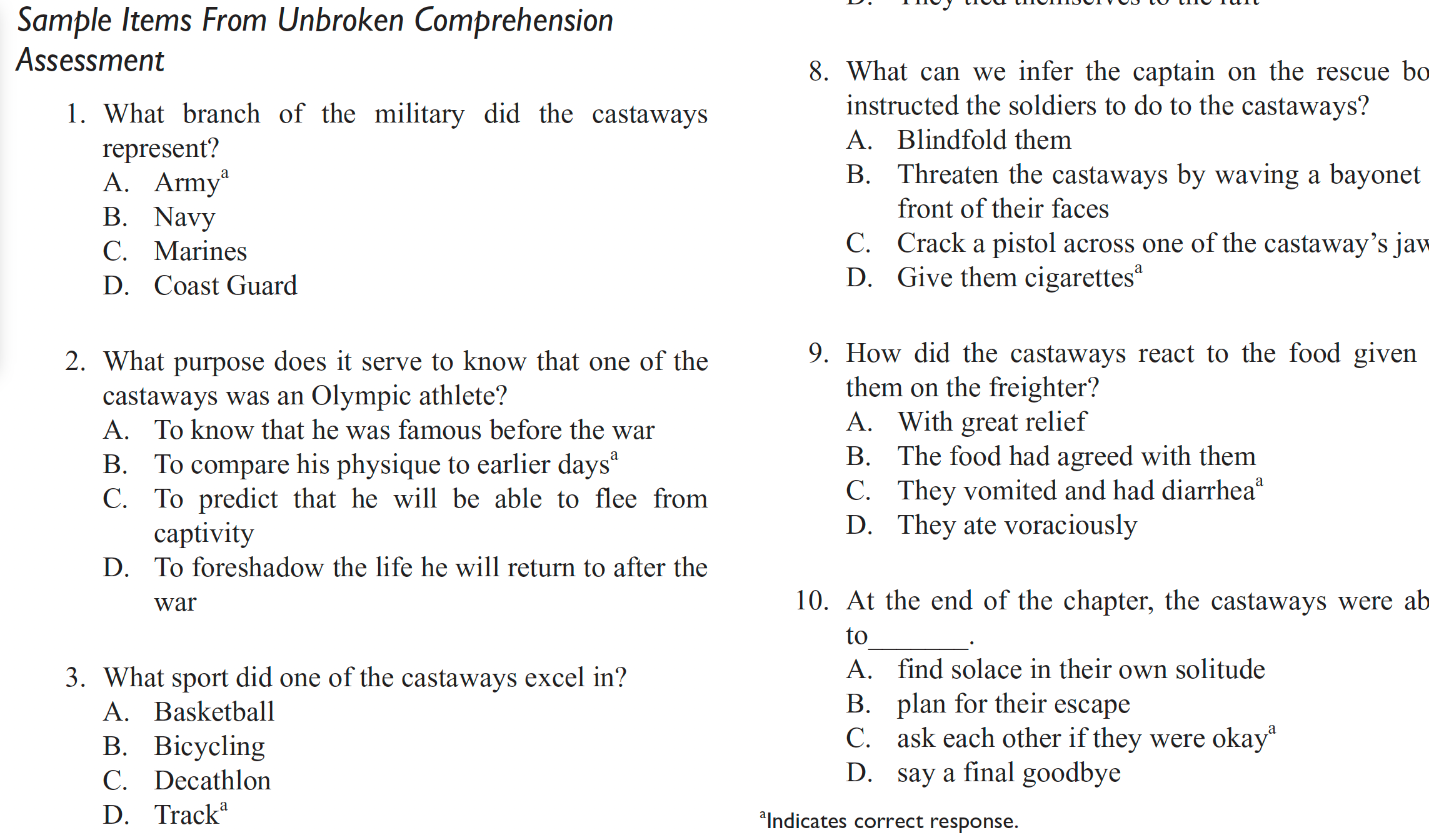
This ‘study’ tested narrative recall among 121 adults from NYC-area coffee shops with degrees (for real) about Unbroken, which is narrative non-fiction, not a book about ideas. Further, this is a confounding study because, as we saw above, there’s no evidence that the two activities are identical for children learning to read, which matters more than the cognitive shortcuts adults want validated.
From the method section:
This text was chosen because it was a fact-based text in the context of a story. The total content contained 3,184 words. Forty eight multiple-choice questions were designed to assess the participants’ recollection of the two aforementioned passages.
The rigor is laughable.
None of the above falsifies my argument, which stands until proven incorrect. No such longitudinal study exists. Until it does, this argument is valid.
If reading and listening produce the same mind, and therefore can be claimed as the same act, then words have no meaning.
That the more difficult activity leads to compounding advantage is accepted in every other area requiring demonstrable skill, yet denied in this one, because this argument is actually about social status claims, not reading.
Writing my way out
You know when you meet someone who’s wrestled with difficult texts. They speak at a different register, have a wider vocabulary, and say more interesting things.
Neil Postman describes the effort required to read a book in Amusing Ourselves to Death, which argues that the medium of information intake determines 1) the possible truths communicable and 2) reshapes the mind of the consumer.
Although the general character of print-intelligence would be known to anyone who would be reading this book, you may arrive at a reasonably detailed definition of it by simply considering what is demanded of you as you read this book. You are required…to remain more or less immobile ofr a fairly long time. […] The printing press makes rather stringent demands on our bodies as well as our minds. […] You must also have learned to pay no attention to the shapes of the leters on the page. […] …you are required to assume an attitude of detachment and objectivity (emphasis mine).3
The typographic mind that Postman describes enables the exercise of reason, which is why we have nice things.
The people angry at me are not blind, dyslexic, or otherwise disabled. They’re largely credentialed white people who don’t like someone with my profile saying she worked harder and got better results, because that invalidates their political framework.
That framework is why standards are eroding throughout society. Credentialed white people are made uneasy by Indian-Americans (or any person of color) beating them at their own game.4 They say they want social mobility, but they also know that competition is real and who’s winning.
I came from nothing. I had no books in my house, my parents didn’t speak English well enough to read to me, nor did they read at all, though they are literate. I come from a generationally poor, anti-intellectual family in which critical thinking was not merely discouraged, but punished.
My mother broke the spine of my first-edition copy of Harry Potter and the Goblet of Fire because she was angry that I was reading so much, socially withdrawn. The people of my mother’s ethnolinguistic group are a particularly loud type. I was quiet and shy, unacceptable.
I was either on AIM, doing Herculean amounts of schoolwork5, or reading Harry Potter fanfiction (I know).
Not only were the girls in my mother’s family discouraged from education, but my father didn’t graduate from high school. My mother, despite earning a degree in India, is among the least intellectual people in my extended family, which is saying something.

I am a loner. In childhood, this was a physical condition, in that I had no friends and was excluded by those I thought were actually friends. In adulthood, it’s a kind of metaphorical loneliness despite having friends.
Reading and writing weren’t just an escape from the chaos at home and loneliness at school. I knew that the way into the world from which my classmates largely came was to develop my intellect, and reading was the vehicle.
Through wide reading, I developed my writing ability, and now both practices give me compounding advantages in my career and in enabling conceptual syntheses for this work. I can take authors’ arguments further and fix shitty data because of the same core skill: pattern recognition honed across disciplines and subjects.
I wrote my way out. I’ve written before about how I see Alexander Hamilton as a kindred spirit in this, who wrote himself into history. He was an autodidact, constantly reading and writing. His personal behavior notwithstanding, I admire him for this reason. He pulled himself into the elite through sustained effort. He is what Postman called the typographic mind, forged in the golden age of literacy.
I didn’t read at all for a decade after graduate school, until I was thirty-two. My attention span was too addled by the phone, and it’s no coincidence that my depression, anxiety, and interpersonal skills were at their worst.
My skill acquisition was compounded only after I developed a reading habit for the first time as an adult. I couldn’t focus long enough to accomplish anything meaningful or push forward.
Now, I read equally difficult books as I did in graduate school, but I actually absorb them, because I’m not addicted to social media as I was then. My knowledge from voluntary, difficult reading is far wider than what I’d have developed by getting another credential, so my pool of available ideas is wider.
The people already born into the credentialed class grew up with books, with parents who read to them, who cared and listened, and with the assumption of college attendance. While my parents wanted me to become more educated than they were, they also didn’t know the first thing about navigating the world of magnet schools and college admissions.
I not only got to college through reading but also basically parented myself, which led to writing. The books provided solace to an otherwise depressed kid who knew that bootstrapping had to happen, and her intellect was the instrument.
For those wondering why I care so much about people claiming they’ve read a book when they haven’t, it’s because lying about the effort to accrue status is offensive to me. I worked harder by reading difficult books and even getting that now-meaningless advanced credential. And this is why I don’t lead with credentials in my writing — it’s another form of intellectual laziness, not to mention an implicit appeal to authority.
Only credentialed people have the luxury of criticizing the bootstrapping mentality more commonly found among the working class, because they already have what we want — a comfortable life. My typographic mind wasn’t a given. It was developed by getting lost in the library in pursuit of a better life.

White people love oral cultures
Finally, we address the vague objections about oral cultures. Those comments weren’t making a true argument; instead, they were gesturing toward cultures considered oppressed, with oral traditions, as some kind of falsification of my argument.
I believe the intention was to argue that I’m discounting cultures that transmitted knowledge orally by arguing that listening is cognitively inferior. The two are unrelated, but oral traditions and native cultures allow progressives to claim that I’m asserting a Western cultural bias with my argument for the written word over the spoken.
White people seem to positively fetishize the spoken word, even though the printing press democratized knowledge and made popular uprisings possible, like the American Revolution. I don’t talk a lot about white people these days, but the comments on the initial argument with these objections were all from white people, almost all women. There’s something there.
I come from a civilization with the longest unbroken oral tradition. All Indic texts were recited exclusively before English and German scholars translated the Sanskrit. They weren’t accessible to all; learning them required extraordinary cognitive effort, not only to memorize but also to recite correctly. To transmit a text in ancient Indic society, one had to not only be a male brahmin but also spend decades learning before one was qualified to transmit the knowledge.
Oral traditions are the opposite of the passive consumption enabled by audiobooks. They arguably require more effort than reading the text itself. The objections I got about oral cultures were imprecise, betraying a lack of knowledge.
The attention spans of knowledge consumers in these societies were far longer than ours today. The proliferation of audiobooks is related to the collapse in attention span caused by phones. The problem raised is that the credentialed still want an intellectual identity despite lacking the attention span to read. Hence, the consternation about audiobooks and the desperate need to prove they’re equivalent to reading.
I come from a culture built on oral transmission of knowledge, but I made something of myself because of the printing press. Anyone who ever got somewhere in life did it through effort, not shortcuts. No one became an expert on a topic by listening to podcasts and books while doing the dishes.
The credentialed class’s legitimacy rests on the monopoly over knowledge production, and yet they utterly disrespect the process by which knowledge is acquired. They launder corporate interests through studies funded by taxpayers. They also devalue their own product by claiming absurdities like the one I dismantled here.
This is a microcosmic example of why the credentialed class is facing a legitimacy crisis. In an effort to save what they control, they’ve devalued it by removing standards and deeming discipline oppressive. The same mechanism I’ve been writing about for years shows up in this manufactured debate about the hierarchy of effort: that convenience is desirable and that standards are oppressive because they create a hierarchy of intellect. Yet, the people they claim to care about want to preserve standards because exceeding them afforded a better life.
I am algorithm-unfriendly. If this resonated, consider becoming a paying subscriber.
I stay away from talking about white people, but you all are just too numerous not to notice trends. But David Dennison has far more analysis of white people than I can provide here.
Rogowsky, B. A., Calhoun, B. M., & Tallal, P. (2016). Does Modality Matter? The Effects of Reading, Listening, and Dual Modality on Comprehension. Sage Open, 6(3).
Neil Postman, Amusing Ourselves to Death, 25.
Progressive and conservative white people have different flavors of anti-Indian sentiment because of the anxieties provoked.
International Baccalaureate, for which I am grateful.
Anuradha, you seem more cutting-edge with every post. Good for you. I find myself wondering about the slog you're embarking.
Nailed it.